
Retirement in West Virginia
Retirees living mainly on Social Security, pensions, or military retirement who want rock-bottom housing costs and four-season mountain life, settled within reach of Morgantown, Charleston, Huntington, or the Eastern Panhandle. Poor fit for those needing frequent specialty care while living remotely.
Fact text
- West Virginia is the only state formed by breaking away from a Confederate state during the Civil War.
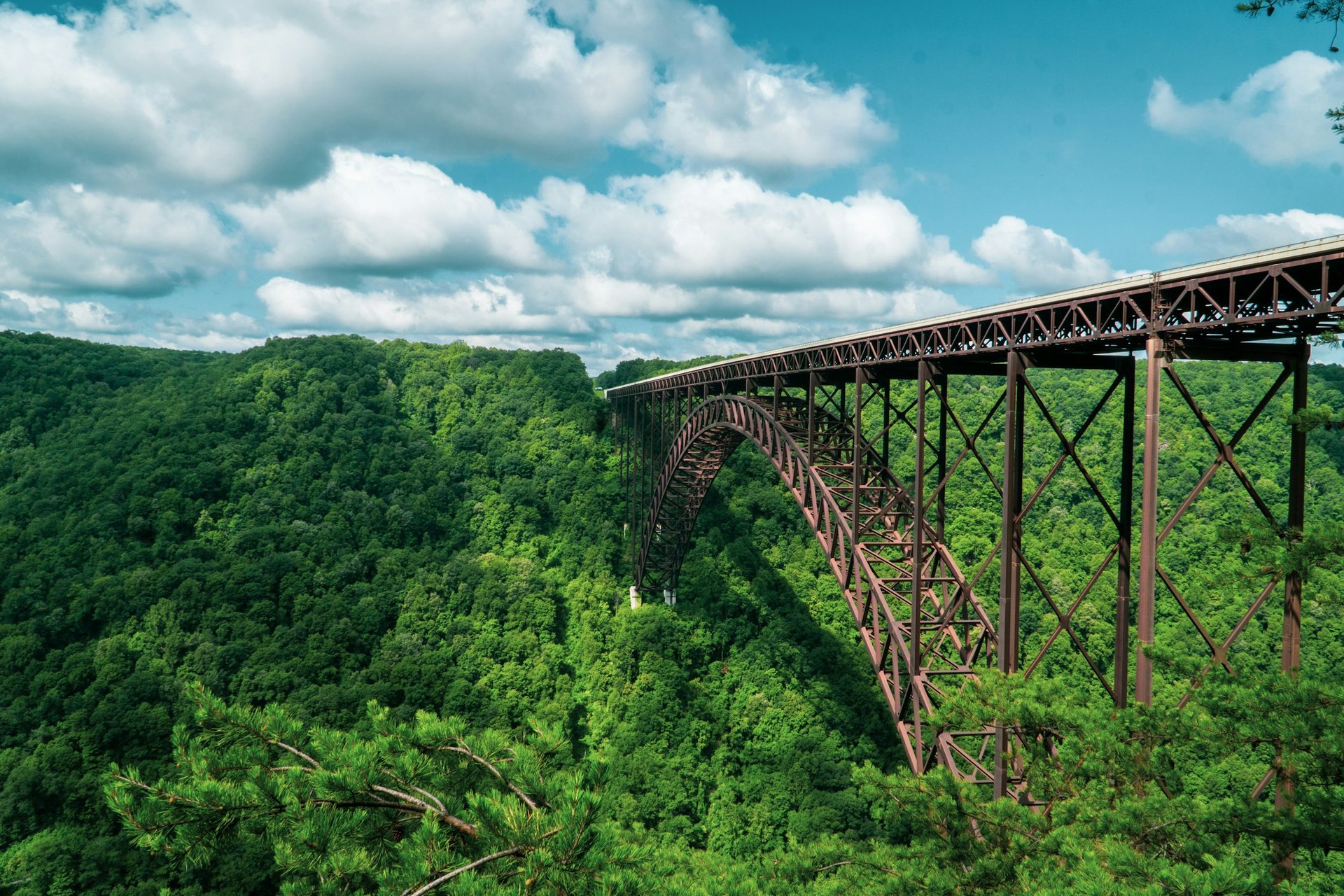
- Once a year on Bridge Day, the New River Gorge Bridge opens to pedestrians and BASE jumpers.
- Green Bank, West Virginia, lies inside the National Radio Quiet Zone, where Wi-Fi and cell signals are restricted to protect a giant radio telescope.
- The first official Mother's Day observance was held in Grafton, West Virginia, in 1908.


- Social Security 100% exempt from state income tax starting with the 2026 tax year
- Lowest typical home value of any state (about $173,000) and cost of living roughly 12% below the U.S. average
- Property taxes among the nation's lowest (about 0.48% effective), plus a $20,000 homestead exemption and refundable senior tax credit for 65+
- Military retirement pay fully exempt; income tax rates falling steadily (2.11%-4.58% for 2026 under SB 392)
- No estate or inheritance tax
- Four-season mountain scenery, uncrowded outdoor recreation (New River Gorge), low congestion
- Eastern Panhandle offers low WV costs within reach of Washington-Baltimore healthcare, airports, and family
- Health outcomes rank near the bottom nationally, and rural hospital closures leave long drives to specialty care
- Pension, IRA, and 401(k) income beyond the $8,000 senior modification is still taxed
- Second-oldest state by share of 65+ population, with decades of population decline shrinking services in many counties
- Among the highest per-capita flood risk in the country; flash flooding in steep valleys is the signature hazard
- Limited air service, retail, dining, and senior amenities outside the few metro corridors
- Broadband and cell coverage still unreliable in remote areas; mountain winters complicate rural travel
West Virginia is quietly becoming one of the most tax-friendly and affordable states in the country for retirees, a fact that surprises people who still picture it as a high-burden former industrial state. The state finished a three-year phase-out of its Social Security tax with the 2026 tax year, cut its income tax rates repeatedly through automatic revenue triggers, fully exempts military retirement pay, and has some of the lowest property taxes and home prices in America. The typical home costs about 173,000 dollars, less than half the national figure.
The other side of the ledger is just as important to state plainly. West Virginia has the second-oldest population profile in the nation, about 21.9 percent of its 1.77 million residents are 65 or older, and decades of population decline have thinned services in many counties. Health outcomes rank near the bottom nationally, rural hospital access is a genuine problem, and the state's steep terrain gives it some of the country's worst per-capita flood risk.
Retiring well in West Virginia is therefore a matter of location. Retirees who settle near Morgantown, Charleston, Huntington, or the Eastern Panhandle, within reach of real medical centers, can capture remarkable affordability and natural beauty. Retirees drawn to remote hollows should weigh the distance to care as seriously as the price of the house.
The Case for Retiring in West Virginia
Affordability leads. The cost of living index is about 87.9, roughly 12 percent below the national average, and housing is the biggest reason: the typical home value of about 173,000 dollars is among the lowest of any state. Property taxes are lower still in relative terms, an effective rate near 0.48 percent, roughly half the national norm, and homeowners 65 and older get a homestead exemption on the first 20,000 dollars of assessed value plus, for lower-income seniors, a refundable Senior Citizens Tax Credit.
Taxes on retirement income keep improving. Beginning with the 2026 tax year, Social Security benefits are 100 percent exempt from state income tax, completing a phase-out that ran 35 percent in 2024 and 65 percent in 2025. Military retirement pay is fully exempt, and residents 65 and older can subtract up to 8,000 dollars of other income. Income tax rates keep falling: for 2026 they range from 2.11 to 4.58 percent across five brackets, after a further 5% across-the-board cut (SB 392, retroactive to January 1, 2026), with more trigger-based cuts possible. There is no estate or inheritance tax.
Beyond the numbers: four genuine seasons, low crime in most areas, uncrowded outdoor recreation from the New River Gorge to state parks, and, in the Eastern Panhandle, easy reach of the Washington-Baltimore metro for family, airports, and specialty care.
The Trade-Offs to Consider
Healthcare is the honest concern. West Virginia consistently ranks near the bottom of state health rankings, and while WVU Medicine in Morgantown and Vandalia Health (CAMC) in Charleston are capable tertiary centers, much of the state depends on small rural hospitals, several of which have closed or cut services in recent years. Specialist wait times and long drives are routine outside the main corridors.
Pension, IRA, and 401(k) income remains taxable beyond the modest 8,000-dollar senior modification, so West Virginia is friendlier to Social Security-centered retirees than to those with large tax-deferred withdrawals. Amenities are thin by design: limited air service (mostly small regional airports), few large retail and dining options outside the metros, and a shrinking population in many counties means fewer services over time, not more. Terrain that makes the state beautiful also makes it hazardous, steep-slope flash flooding is the state's signature disaster, with repeated deadly events in the past decade, and winter storms and landslides complicate mountain travel. Broadband and cell coverage, though improving, are still unreliable in remote areas.
Taxes for Retirees in West Virginia
These rules reflect the 2026 tax year for Social Security and the 2025 published rates for income tax brackets.
Social Security: Fully exempt from state income tax starting with the 2026 tax year, the final step of a three-year phase-out (35 percent exempt in 2024, 65 percent in 2025, 100 percent in 2026).
Pensions, IRAs, and 401(k)s: Generally taxable, with an 8,000-dollar senior modification for residents 65 and older (16,000 for a married couple where both qualify). Certain public-safety pensions (state police, some police and fire plans) are exempt, and military retirement pay is fully exempt.
Income tax rates: 2.11 percent to 4.58 percent across five brackets for 2026 (SB 392's 5% cut, retroactive to January 1, 2026), after successive cuts from 6.5% in 2022. The state's trigger mechanism can reduce rates further in future years.
Sales tax: 6 percent state rate; average combined state and local rate about 6.59 percent. Groceries are exempt from the state sales tax.
Property tax: Among the lowest in the nation, roughly 0.48 percent effective. The Homestead Exemption removes the first 20,000 dollars of assessed value for owner-occupants 65 or older (or totally disabled), and the refundable Senior Citizens Tax Credit offsets property tax for lower-income seniors.
Estate and inheritance tax: None.
Confirm current-year details with the West Virginia Tax Division or a tax professional, rates have been changing almost annually as triggers fire.
Cost of Living and Housing
West Virginia's composite cost index of 87.9 makes it one of the most affordable states, and housing is the anchor: the typical home value of about 173,000 dollars is the lowest of any state. A retiree selling a median-priced home almost anywhere else can buy comfortably here and bank the difference. Costs are lowest in the southern coalfield counties, where services are also thinnest, and highest in the Eastern Panhandle (Martinsburg, Charles Town, Shepherdstown), which functions economically as an outer suburb of the D.C. metro, and around Morgantown. Utilities and healthcare costs run close to national averages, so the savings are concentrated in housing and taxes.
Healthcare for Retirees
WVU Medicine, anchored by J.W. Ruby Memorial Hospital in Morgantown, is the state's flagship academic system and has expanded across the north. Vandalia Health, built around Charleston Area Medical Center, anchors the south, with Marshall Health serving Huntington. Eastern Panhandle residents commonly use WVU Medicine facilities there or cross into Maryland and Virginia for care. The structural problems are real: the state has high rates of chronic disease, some of the nation's worst health-outcome rankings, and thin rural coverage, several rural hospitals have closed or reduced services. The practical advice for relocating retirees is simple: pick a home within a reasonable drive of Morgantown, Charleston, Huntington, or the Panhandle corridors, and check Medicare Advantage network adequacy carefully in rural counties.
Climate and Natural-Disaster Risk
West Virginia has a four-season mountain climate: warm, humid summers in the valleys, cooler at elevation, and cold, snowy winters, especially in the highlands, which see genuine snowfall totals. The state's defining hazard is flooding: steep terrain funnels heavy rain into narrow valleys, producing flash floods that have repeatedly caused fatalities and property destruction, and FEMA risk data consistently rates West Virginia flood exposure high for its size. Landslides accompany the same terrain, and winter ice and snow complicate rural roads. Hurricanes weaken to rain events by the time they arrive, and tornado and earthquake risks are low. Retirees should check flood-plain maps before buying, many of the cheapest properties are cheap partly because they sit near water.
Annuities and Retirement Income in West Virginia
For West Virginia retirees, the arrival of the full Social Security exemption changes the income-planning picture: a retiree whose base income is Social Security plus a modest annuity or pension may owe very little state tax at all, while large IRA withdrawals are still taxed at up to about 4.82 percent. Guaranteed-income products such as fixed annuities can make sense here for the same reason they do anywhere, converting a portion of savings into dependable monthly income that outlasts market cycles, and the state's low living costs mean a given payout stretches further.
Annuities in West Virginia are backstopped by the West Virginia Life and Health Insurance Guaranty Association, which covers up to 250,000 dollars in present value of annuity benefits per contract owner if a member insurer fails, subject to an overall cap of 300,000 dollars per individual across coverages. Keep any single insurer's contracts within the guaranty limit and compare surrender terms, not just rates.
Who West Virginia Suits Best
West Virginia suits retirees whose income leans on Social Security, a pension, or military retirement, who want the lowest realistic housing costs east of the Mississippi, and who love four-season mountain life more than metropolitan amenities. The Eastern Panhandle offers a practical compromise, low West Virginia costs with D.C.-area healthcare and airports nearby. It is a poor fit for retirees who need frequent specialty care but want to live remotely, or who expect big-city dining, shopping, and direct flights.
Does West Virginia tax Social Security benefits?
Not anymore. West Virginia phased out its Social Security tax over three years, 35% exempt in 2024, 65% in 2025, and 100% exempt beginning with the 2026 tax year (returns filed in 2027). All Social Security benefits are now free of West Virginia income tax.
How does West Virginia tax pensions, IRAs, and 401(k) withdrawals?
They are generally taxable at rates of 2.11% to 4.58% (2026), but residents 65 and older can subtract $8,000 of income ($16,000 for a qualifying couple). Military retirement pay is fully exempt, as are certain public-safety pensions. Rates have been falling through automatic revenue triggers.
How cheap is housing in West Virginia for retirees?
The typical home value is about $173,000, the lowest of any U.S. state, and the effective property tax rate of roughly 0.48% is among the nation's lowest. Homeowners 65 and older also get a homestead exemption on the first $20,000 of assessed value, and lower-income seniors can claim a refundable Senior Citizens Tax Credit.
What is healthcare like for retirees in West Virginia?
It depends heavily on location. WVU Medicine in Morgantown and Vandalia Health (CAMC) in Charleston provide strong tertiary care, and Marshall Health serves Huntington, but many rural counties rely on small hospitals with limited services. The state ranks near the bottom nationally in health outcomes, so retirees should choose a home within a reasonable drive of a major medical corridor.
Does West Virginia have an estate or inheritance tax?
No. West Virginia has neither an estate tax nor an inheritance tax, so only federal estate tax rules apply to West Virginia estates.
How are annuities protected in West Virginia if an insurer fails?
The West Virginia Life and Health Insurance Guaranty Association covers up to $250,000 in present value of annuity benefits per contract owner if a member insurer becomes insolvent, subject to a $300,000 overall cap per individual across coverage types. Keeping any single insurer's contracts within that limit is a common precaution.
Keep Learning
Free retirement education from Annuities.net — no signup required.

Empower Your Retirement Planning: How to Evaluate Annuity Options
Learn how to evaluate annuity options, weigh the trade-offs, and build a secure retirement plan. Use independent education from Annuities.net to make informed decisions and plan for steady lifetime income.
Read more

Why Independent Annuity Guidance Makes a Difference for Your Nest Egg
Independent, unbiased annuity guidance helps protect your nest egg by offering clear, conflict-free information. Use the free educational resources at Annuities.net to make informed retirement planning decisions.
Read more

Unlock Your Retirement Potential: Why Independent Financial Advice Matters
Independent financial advice is crucial for unbiased, personalized retirement planning. Annuities.net offers free, transparent education and a match with a licensed advisor to help secure steady income and financial peace of mind.
Read more
Not sure if an annuity is right for you?
Select the annuity that fits your financial plan. No pressure, always transparent.