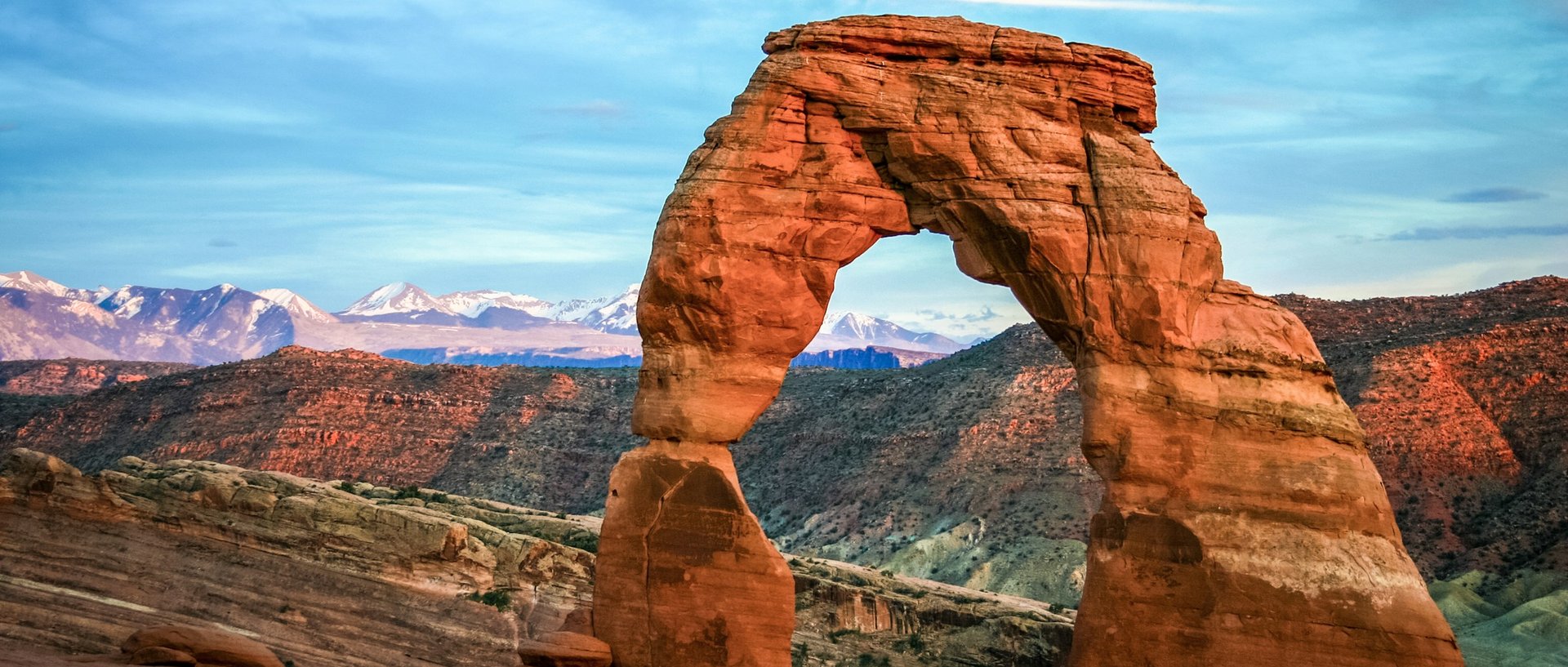

Retirement in Utah
Active, outdoors-oriented retirees — especially veterans and middle-income Social Security households — who value excellent healthcare, low property taxes, and mountain or red-rock scenery, and who can absorb Utah's high home prices.
Fact text
- Utah's 'Mighty 5' national parks — Zion, Bryce Canyon, Arches, Canyonlands, and Capitol Reef — sit within a few hours' drive of one another.
- The Great Salt Lake is the largest saltwater lake in the Western Hemisphere.
- A single aspen grove in central Utah named Pando is considered one of the largest living organisms on Earth.
- Utah trademarked the phrase 'The Greatest Snow on Earth' for the famously light powder in its mountains.


- Low flat income tax of 4.45% (2026), cut six years running, with no estate or inheritance tax
- Social Security credit eliminates state tax on benefits for most middle-income retirees (up to ~$54,000 single / $90,000 joint AGI)
- Military retirement pay is effectively exempt through a dedicated credit
- Low property taxes — about 0.48% effective rate on owner-occupied homes
- Highly rated healthcare anchored by Intermountain Health and University of Utah Health, and one of the healthiest state populations
- World-class outdoor recreation: five national parks, Wasatch ski resorts, and a very active senior lifestyle culture
- Four-season but relatively dry climate; Salt Lake City International is a Delta hub with broad direct-flight access
- Housing is expensive — Zillow's typical home value of about $541,000 is well above the national level
- Most retirement income (pensions, IRA/401(k)) is fully taxed at the flat rate, and higher-income retirees pay tax on Social Security too
- Earthquake risk along the Wasatch Fault, where most of the population lives, plus wildfire, drought, and flash-flood hazards
- Winter temperature inversions trap poor air quality in the Salt Lake Valley — a real issue for retirees with respiratory conditions
- The youngest age profile in the nation (12.4% 65+) means fewer retiree-dense communities outside St. George
- Snowy winters along the Wasatch Front; southern Utah summers regularly top 100°F
- Senior property tax relief has low income caps, offering little help to middle-income homeowners
Utah sells itself on lifestyle: five national parks, the Wasatch mountains, St. George's warm red-rock winters, and one of the healthiest, most active populations in the country. For retirees, the practical fundamentals are more mixed than the scenery — Utah taxes most retirement income at a flat 4.45%, and its housing costs have climbed well above the national norm — but the state pairs those costs with genuinely low property taxes, a Social Security credit that spares most middle-income retirees, strong healthcare, and no estate tax.
Utah is also, statistically, the nation's youngest state: just 12.4% of its 3.5 million residents are 65 or older. That cuts both ways. Retirees here join multigenerational communities rather than retiree enclaves — with the notable exception of the St. George area, a genuine retirement magnet — and public life tilts toward families and recreation rather than senior-focused amenities.
The decision usually comes down to this: if the mountains or the desert Southwest are calling and your budget can handle a roughly $541,000 typical home price, Utah's tax and healthcare picture is friendlier than its reputation suggests.
The Case for Retiring in Utah
Utah's income tax is flat and falling — 4.45% for 2026, the sixth cut in as many years. Social Security is technically taxable, but a nonrefundable credit erases the state tax on benefits for single filers with income up to about $54,000 and joint filers up to $90,000, with a phase-out above; the legislature has repeatedly expanded these thresholds. Military retirees do even better: a dedicated credit equal to the tax rate times qualifying military retirement pay effectively exempts it. There is no estate or inheritance tax.
Property taxes are a quiet strength — about 0.48% effective on owner-occupied homes, among the lowest third of states — because Utah exempts 45% of a primary residence's value from taxation. Sales taxes are middling: a 6.1% state rate and roughly 7.2% average combined.
Healthcare is a legitimate draw. Intermountain Health is one of the most studied high-value health systems in the country, University of Utah Health anchors academic medicine with the Huntsman Cancer Institute, and Utah's population consistently ranks among America's healthiest. Salt Lake City International, a Delta hub, provides direct flights across the country.
Then there is the lifestyle: skiing, hiking, golf in St. George from fall through spring, and Zion, Bryce Canyon, Arches, Capitol Reef, and Canyonlands all in-state.
The Trade-Offs to Consider
Housing is the biggest. Zillow's typical Utah home value was about $541,000 in spring 2026 — hundreds of thousands above the U.S. typical value — and the desirable retirement markets (Wasatch Front, Park City, St. George) run at or above that. Overall cost of living lands at the national average only because non-housing costs are moderate.
Taxes on retirement income are the second. Unlike its no-income-tax neighbors Nevada and Wyoming, Utah taxes pensions and IRA/401(k) withdrawals in full at the flat rate, and retirees above the Social Security credit thresholds pay tax on benefits as well. The property tax circuit breaker for seniors 66+ carries low income limits, so most middle-income homeowners get no special relief beyond the standard residential exemption.
Natural hazards are less famous than Florida's but real: most Utahns live along the Wasatch Fault, capable of a major earthquake; wildfire and drought are chronic; and southern Utah sees flash floods and extreme heat. A quieter issue is air quality — winter inversions trap pollution in the Salt Lake Valley for days or weeks, a meaningful concern for anyone with respiratory or cardiac conditions.
Finally, culture and demographics: Utah's communities are young and family-centric, and social life in much of the state is influenced by the predominant faith community. Many retirees find this welcoming; some transplants find it an adjustment.
Taxes for Retirees in Utah
Utah applies a flat 4.45% income tax (2026, down from 4.5% in 2025) to most income, including pensions and retirement account withdrawals — there is no general retirement income exclusion.
Social Security: benefits are included in Utah taxable income, but the Social Security tax credit offsets the full state tax for joint filers with income up to $90,000, single filers up to about $54,000, and married-filing-separately up to $45,000, phasing out above those levels. In practice, most middle-income retirees pay no Utah tax on Social Security.
Military retirement: a nonrefundable credit equal to the tax rate multiplied by qualifying military retirement pay effectively zeroes out the state tax on it (you cannot claim this and the general retirement credit together).
Sales tax: 6.1% state rate, about 7.2% average combined. Groceries are taxed at a reduced statewide rate.
Property tax: roughly 0.48% effective, helped by the 45% primary-residence exemption. The circuit-breaker program for homeowners and renters 66+ with low household incomes can abate over $1,000 plus a further credit tied to home value, and counties offer hardship and veteran abatements — but income caps are strict. Utah has no estate or inheritance tax. Confirm current credit thresholds with the Utah State Tax Commission or a tax professional, as they adjust regularly.
Cost of Living and Housing
Utah's composite cost of living index was 100.6 in Q1 2026 — essentially the national average — but that average hides expensive housing offset by moderate everything else. The typical home value of $540,993 (April 2026, up 1.6% year over year) exceeds every neighboring state except Colorado's resort corridors. St. George, the state's retirement hub, has appreciated rapidly for two decades; Salt Lake and Utah counties are supply-constrained between mountains and lake. Retirees arriving from lower-cost states should run the housing math first; those arriving from California often still come out ahead.
Healthcare for Retirees
Utah pairs an unusually healthy population with well-run systems. Intermountain Health operates hospitals and clinics statewide, including Intermountain Medical Center in Murray and St. George Regional in the south; University of Utah Health provides academic medicine, and its Huntsman Cancer Institute is the region's premier cancer center. Care along the Wasatch Front and in Washington County (St. George) is strong; rural central and eastern Utah is much thinner, with long drives to specialists. Winter inversions in the Salt Lake Valley aggravate respiratory conditions — retirees with COPD or asthma sometimes prefer benches above the valley floor or southern Utah for that reason.
Climate and Natural-Disaster Risk
Utah is dry and sunny with true seasons. Northern Utah winters bring cold and snow (a feature for skiers, a chore for everyone else), while summers are warm and arid. St. George enjoys mild winters and endures very hot summers. The state's hazard list is led by earthquake risk on the Wasatch Fault — where roughly 80% of Utahns live — followed by wildfire, drought, flash flooding in slot-canyon and burn-scar country, and severe winter storms in the mountains. Homeowners should ask specifically about earthquake insurance (excluded from standard policies) and wildfire exposure when choosing a property.
Annuities and Retirement Income in Utah
Because Utah taxes pension and account withdrawals at a flat 4.45%, annuity income is likewise taxed at that rate (Social Security interplay aside) — simple to plan around, if not free. Guaranteed-income products can complement Social Security for retirees who want predictable income against market swings and longevity, with the usual trade-offs in liquidity and fees to weigh carefully.
If a licensed insurer were to fail, the Utah Life & Health Insurance Guaranty Association protects annuity benefits up to $250,000 in present value per contract owner, regardless of how many contracts you held with that insurer.
Who Utah Suits Best
Utah rewards active retirees who will actually use the mountains, trails, and parks; veterans, whose retirement pay is effectively state-tax-free; and middle-income Social Security households who fall under the credit thresholds. St. George suits sun-seekers who want Arizona-style winters with Utah healthcare and scenery. Utah is a weaker fit for budget-constrained buyers priced out by a $541,000 typical home value, for retirees with respiratory conditions considering the Salt Lake Valley, and for those with large pension or IRA incomes comparing against no-income-tax Nevada or Wyoming next door.
Does Utah tax Social Security benefits?
Technically yes, but a state credit eliminates the tax for most retirees. For 2026 the full Social Security credit applies up to roughly $54,000 of income for single filers and $90,000 for joint filers, phasing out above those levels. Higher-income retirees pay Utah's flat 4.45% rate on taxable benefits.
How does Utah tax pensions and 401(k) or IRA withdrawals?
They are taxed as ordinary income at Utah's flat rate — 4.45% in 2026 — with no general retirement exclusion. Military retirement is the exception: a dedicated credit effectively exempts qualifying military retirement pay from state tax.
Is Utah expensive for retirees?
Overall cost of living is right at the national average (index 100.6, Q1 2026), but housing is the pressure point: Zillow's typical Utah home value was about $541,000 in spring 2026. Property taxes are low at roughly 0.48% effective, and there is no estate or inheritance tax.
How good is healthcare in Utah for retirees?
Strong along the Wasatch Front and in St. George. Intermountain Health is a nationally recognized system, and University of Utah Health includes the Huntsman Cancer Institute. Rural central and eastern Utah have much thinner coverage, and winter air inversions in the Salt Lake Valley can aggravate respiratory conditions.
What natural disaster risks does Utah have?
The Wasatch Fault, where most of the population lives, poses genuine earthquake risk, and standard homeowners policies exclude earthquakes. Wildfire, drought, flash flooding, mountain winter storms, and extreme heat in southern Utah round out the list.
How are annuities protected in Utah?
The Utah Life & Health Insurance Guaranty Association covers annuity benefits up to $250,000 in present value per contract owner if a licensed insurer fails.
Keep Learning
Free retirement education from Annuities.net — no signup required.

Empower Your Retirement Planning: How to Evaluate Annuity Options
Learn how to evaluate annuity options, weigh the trade-offs, and build a secure retirement plan. Use independent education from Annuities.net to make informed decisions and plan for steady lifetime income.
Read more

Why Independent Annuity Guidance Makes a Difference for Your Nest Egg
Independent, unbiased annuity guidance helps protect your nest egg by offering clear, conflict-free information. Use the free educational resources at Annuities.net to make informed retirement planning decisions.
Read more

Unlock Your Retirement Potential: Why Independent Financial Advice Matters
Independent financial advice is crucial for unbiased, personalized retirement planning. Annuities.net offers free, transparent education and a match with a licensed advisor to help secure steady income and financial peace of mind.
Read more
Not sure if an annuity is right for you?
Select the annuity that fits your financial plan. No pressure, always transparent.