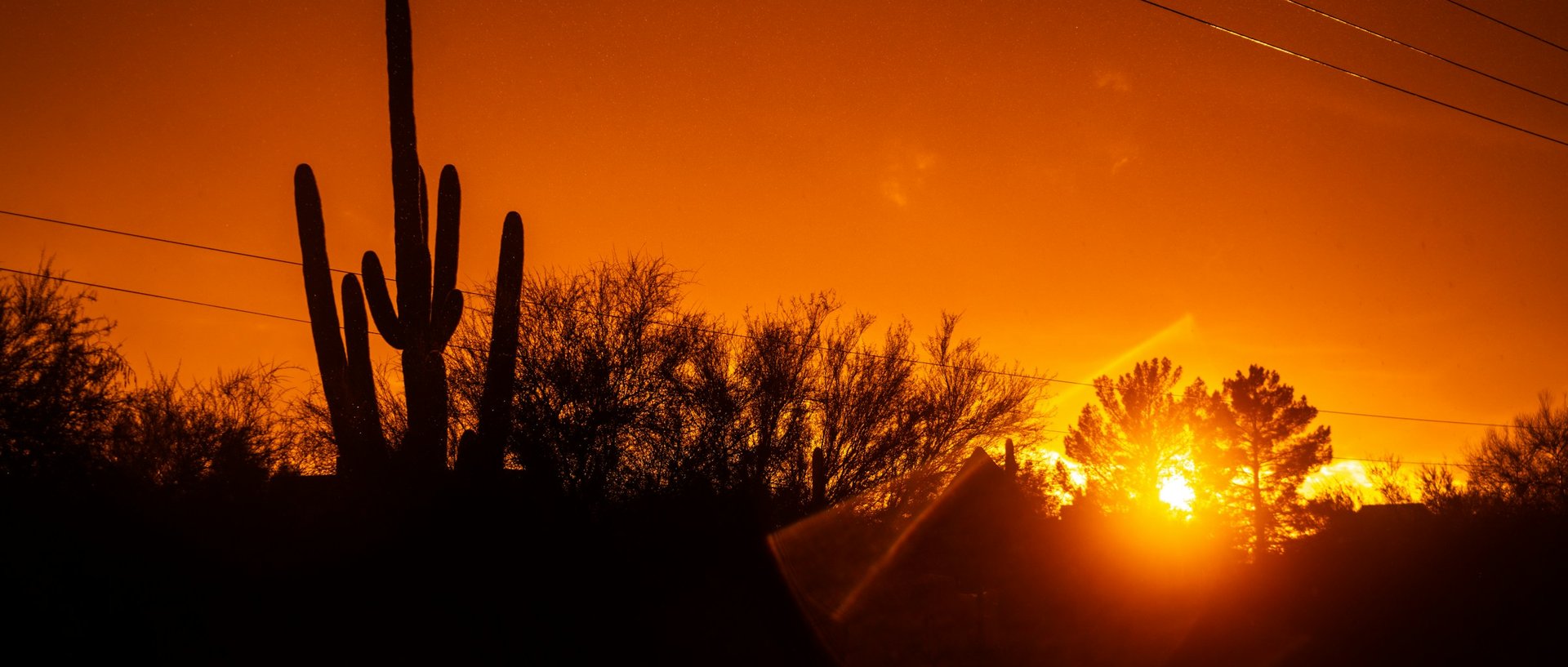

Retirement in Arizona
Retirees who want winter sunshine, low and simple taxes, mature active-adult communities, and metro-quality healthcare - especially military retirees - and who can handle (or seasonally escape) extreme summer heat at today's higher housing prices.
Fact text
- Sun City, opened in 1960, was America's first master-planned retirement community
- Most of Arizona never changes its clocks, skipping daylight saving time — though the Navajo Nation within the state observes it
- The actual London Bridge was dismantled, shipped across the Atlantic, and rebuilt stone by stone in Lake Havasu City
- Arizona joined the Union on Valentine's Day 1912, the last of the contiguous 48 states


- Flat 2.5% income tax - the lowest flat rate in the U.S. - with Social Security fully exempt
- Military retirement and Railroad Retirement fully exempt; $2,500 exclusion for government pensions
- Effective property tax rate about 0.45%, plus the Senior Property Valuation Protection freeze at 65+
- Warm, dry, sunny winters ideal for year-round outdoor activity from fall through spring
- Deep retirement infrastructure: Sun City-style active-adult communities, senior services, and age-targeted amenities
- Nationally ranked healthcare in metro Phoenix (Mayo Clinic Phoenix) plus strong systems in Tucson
- No estate or inheritance tax
- Extreme summer heat - Phoenix sees extended stretches at or above 110F, and heat deaths fall hardest on older adults
- Cost of living about 7.6% above the U.S. average, with a typical home value near $424,000 (above the national norm)
- Long-term Colorado River / groundwater uncertainty, a real factor for well-dependent or fringe communities
- Significant wildfire risk in forested high country and wildland-urban-interface areas, with rising insurance costs there
- IRA/401(k) withdrawals and private pensions are taxed (albeit at only 2.5%)
- Winter-season crowding: traffic, longer medical wait times, and seasonal price bumps in retiree-heavy areas
- Monsoon flash flooding and dust storms during summer
Arizona has been one of America's signature retirement destinations for half a century, and the fundamentals behind that reputation still hold: abundant sunshine, warm dry winters, a low flat income tax that never touches Social Security, low property taxes with a valuation freeze for seniors, and some of the country's largest and best-developed retirement communities. Metro Phoenix and Tucson also offer serious healthcare, headlined by Mayo Clinic's highly ranked Phoenix campus.
But the Arizona of 2026 is not the bargain it was a generation ago. The state's cost of living now runs modestly above the national average, and the typical home value — about $424,000 — exceeds the U.S. norm. Summers are the mirror image of the famous winters: Phoenix routinely endures weeks above 110°F, and extreme heat is now the state's deadliest weather hazard, particularly for older adults. Long-term water supply is a genuine question mark for the desert Southwest, and wildfire risk shadows the forested high country.
If you are weighing Arizona, the honest framing is this: it remains an excellent retirement state for winter livability, taxes, and amenities — provided you go in with clear eyes about heat, water, and today's higher price of admission.
The Case for Retiring in Arizona
A simple, low income tax. Arizona has a flat 2.5% individual income tax — the lowest flat rate in the country. Social Security benefits are fully exempt. Even fully taxable 401(k) or IRA withdrawals face only 2.5% at the state level, a fraction of what most income-tax states charge.
Military and Railroad Retirement exempt; a break for government pensions. Military retirement pay is fully exempt. Federal, Arizona state, and Arizona local government pensions qualify for a $2,500 annual exclusion.
Low property taxes with a senior freeze. Arizona's effective property tax rate is roughly 0.45%, among the lowest in the nation. The Senior Property Valuation Protection Option lets qualifying homeowners 65 and older freeze their home's assessed valuation for renewable three-year periods, protecting fixed incomes from valuation spikes.
Winter climate that sells itself. From October through April, the desert lowlands offer dry air, mild temperatures, and near-constant sunshine — ideal for golf, hiking, and simply being outdoors when much of the country is iced in.
Mature retirement infrastructure. Sun City, Sun City West, Green Valley, and dozens of active-adult communities pioneered the category; the ecosystem of senior services, clubs, and age-targeted housing is among the deepest anywhere.
Top-tier healthcare in the metros. Mayo Clinic's Phoenix campus is nationally ranked, and Banner Health, HonorHealth, and Tucson's academic and community hospitals give the two big metros strong depth.
No estate or inheritance tax.
The Trade-Offs to Consider
Extreme summer heat. Phoenix summers now regularly string together weeks at or above 110°F, and heat-related deaths — concentrated among older adults — have climbed. June through September is an indoor season in the low desert, with high cooling bills; retirees sensitive to heat should consider higher-elevation towns (Prescott, Flagstaff, Payson) or a summer exit plan.
No longer cheap. Arizona's cost of living index is about 107.6 (MERIC Q1 2026), and the typical home value of roughly $424,000 (Zillow, May 2026) is above the national average. The affordability edge over coastal states remains, but the edge over most of the country has narrowed or disappeared.
Water uncertainty. The Colorado River system remains under long-term strain, and groundwater rules are tightening. Established metro utilities have diverse supplies and decades of planning, but water is a legitimate factor when evaluating fringe or unincorporated areas dependent on wells or hauled water.
Wildfire and monsoon hazards. Forested high country faces significant wildfire risk, and summer monsoon storms bring flash flooding and dust storms that make desert driving dangerous.
Retirement-account withdrawals are taxed. The 2.5% rate is low, but unlike several no-tax states, Arizona does tax IRA/401(k) distributions and private pensions (beyond the modest government-pension exclusion).
Seasonal crowding. Winter visitor season brings traffic, longer medical wait times, and higher seasonal prices in retiree-heavy areas.
Taxes for Retirees in Arizona
Figures reflect the 2025 tax year unless noted:
- Income tax: flat 2.5% on taxable income — the lowest flat rate of any income-tax state.
- Social Security: fully exempt from Arizona income tax.
- Pensions: up to $2,500 per year of federal civil-service and Arizona state/local government pension income is excluded; private pensions are taxable at 2.5%. Military retirement and Railroad Retirement benefits are fully exempt.
- 401(k)/IRA withdrawals: taxable at the flat 2.5% rate.
- Sales tax: 5.6% state rate (technically a transaction privilege tax); average combined state and local rate about 8.54% (Tax Foundation, midyear 2026) — above the national average.
- Property tax: effective rate about 0.45%. Homeowners 65+ meeting income limits (for 2026 applications: average total income of $47,712 for one owner or $59,640 for two or more owners, adjusted annually) can freeze their property's valuation under the Senior Property Valuation Protection Option; a small property tax credit exists for very low-income seniors.
- Estate/inheritance tax: none.
Confirm specifics with the Arizona Department of Revenue and your county assessor (the senior freeze is applied for at the county level), and review details with a tax professional.
Cost of Living and Housing
Arizona overall runs about 7-8% above the national average, driven chiefly by housing. The typical home value near $424,000 masks a wide spread: Scottsdale, Paradise Valley, and parts of north Phoenix run far higher, while Tucson, Casa Grande, Sierra Vista, and many outlying communities remain meaningfully cheaper. Summer electricity for cooling is a significant budget item in the low desert — often the year's largest utility expense — while winter heating costs are minimal. Homeowners insurance has been rising in wildfire-exposed foothill and forest communities.
Healthcare for Retirees
Metro Phoenix and Tucson offer healthcare depth few retirement regions can match: Mayo Clinic Phoenix is consistently ranked among the nation's best hospitals, alongside Banner University Medical Center (Phoenix and Tucson), HonorHealth's Scottsdale-area hospitals, and Tucson Medical Center. Geriatric, cardiac, orthopedic, and oncology services are extensive, reflecting the large senior population. The caveats: rural and border counties have thin coverage with long drives to specialists, and the winter influx of seasonal residents can stretch appointment availability. Retirees settling outside the metros should map realistic drive times to hospital care.
Climate and Natural-Disaster Risk
Low-desert Arizona (Phoenix, Tucson, Yuma) delivers mild, sunny winters and extreme summers; high-country Arizona (Prescott, Payson, Flagstaff) trades harsher winters for cooler summers. The state's principal hazards are extreme heat — now the deadliest weather risk, especially for seniors — wildfire in forested and wildland-urban-interface areas, monsoon flash flooding, and dust storms. Earthquake and hurricane risk are minimal. Long-term drought and Colorado River shortages are a structural, slow-moving risk to watch rather than an acute danger in established metro areas.
Annuities and Retirement Income in Arizona
Arizona's flat 2.5% tax treats annuity income gently: payments from qualified annuities are taxable but at one of the lowest state rates in the country, and Social Security's exemption means guaranteed-income stacking (Social Security plus an annuity floor covering essential expenses) is tax-efficient here. Annuities are long-term commitments — evaluate surrender periods, fees, optional riders, and above all the insurer's financial strength.
If a licensed insurer fails, the Arizona Life and Disability Insurance Guaranty Fund covers up to $250,000 per person in present value of annuity benefits, including net cash surrender values. That per-carrier backstop is a practical argument for splitting very large annuity allocations among multiple highly rated insurers. The Arizona Department of Insurance and Financial Institutions (DIFI) can confirm any company's and agent's license status.
Who Arizona Suits Best
Arizona fits retirees who prize winter sunshine and an outdoor lifestyle eight months of the year, want low income and property taxes with simple rules, and value deep senior infrastructure and metro-quality healthcare. It suits military retirees especially well. It is a tougher fit for those who cannot tolerate extreme summer heat and don't want to become seasonal migrants, buyers counting on bargain housing, or anyone planning to settle far from the Phoenix or Tucson medical orbits with significant health needs.
Does Arizona tax Social Security benefits?
No. Arizona fully exempts Social Security benefits from state income tax. Other retirement income, such as IRA or 401(k) withdrawals, is taxed - but only at the state's flat 2.5% rate, the lowest flat income tax in the country.
How does Arizona tax pensions and retirement account withdrawals?
Military retirement and Railroad Retirement benefits are fully exempt. Federal and Arizona government pensions get a $2,500 annual exclusion, with the remainder taxed at 2.5%. Private pensions and 401(k)/IRA withdrawals are taxable at the flat 2.5% rate.
What property tax breaks do Arizona seniors get?
Arizona's effective property tax rate is already low at roughly 0.45%. In addition, the Senior Property Valuation Protection Option lets qualifying homeowners 65 and older (subject to income limits) freeze their home's assessed valuation for renewable three-year periods, applied for through the county assessor.
How hot does it really get in Arizona?
Very hot. Phoenix routinely records extended stretches at or above 110F in summer, and extreme heat is now Arizona's deadliest weather hazard, with older adults most at risk. Many retirees plan summer travel or choose higher-elevation towns like Prescott or Flagstaff, which run 15-25 degrees cooler.
Is Arizona still an affordable place to retire?
It is no longer cheap. Arizona's cost of living index is about 107.6 (MERIC, Q1 2026) and the typical home value is roughly $424,000 (Zillow, May 2026) - both above the national average. It remains far cheaper than coastal California, and Tucson and smaller cities cost meaningfully less than metro Phoenix.
Should I worry about water if I retire in Arizona?
Established metro utilities have diverse supplies and decades of shortage planning, so near-term risk in cities is low. The long-term Colorado River and groundwater picture is a real consideration, especially for homes on private wells or in unincorporated fringe areas - worth investigating before buying there.
Are annuities protected if an insurance company fails in Arizona?
Yes, within limits. The Arizona Life and Disability Insurance Guaranty Fund covers up to $250,000 per person in present value of annuity benefits, including cash surrender values, if a licensed insurer becomes insolvent. Choosing financially strong carriers - and splitting large amounts across insurers - remains the first line of defense.
Keep Learning
Free retirement education from Annuities.net — no signup required.

Empower Your Retirement Planning: How to Evaluate Annuity Options
Learn how to evaluate annuity options, weigh the trade-offs, and build a secure retirement plan. Use independent education from Annuities.net to make informed decisions and plan for steady lifetime income.
Read more

Why Independent Annuity Guidance Makes a Difference for Your Nest Egg
Independent, unbiased annuity guidance helps protect your nest egg by offering clear, conflict-free information. Use the free educational resources at Annuities.net to make informed retirement planning decisions.
Read more

Unlock Your Retirement Potential: Why Independent Financial Advice Matters
Independent financial advice is crucial for unbiased, personalized retirement planning. Annuities.net offers free, transparent education and a match with a licensed advisor to help secure steady income and financial peace of mind.
Read more
Not sure if an annuity is right for you?
Select the annuity that fits your financial plan. No pressure, always transparent.